About the artist
Biography
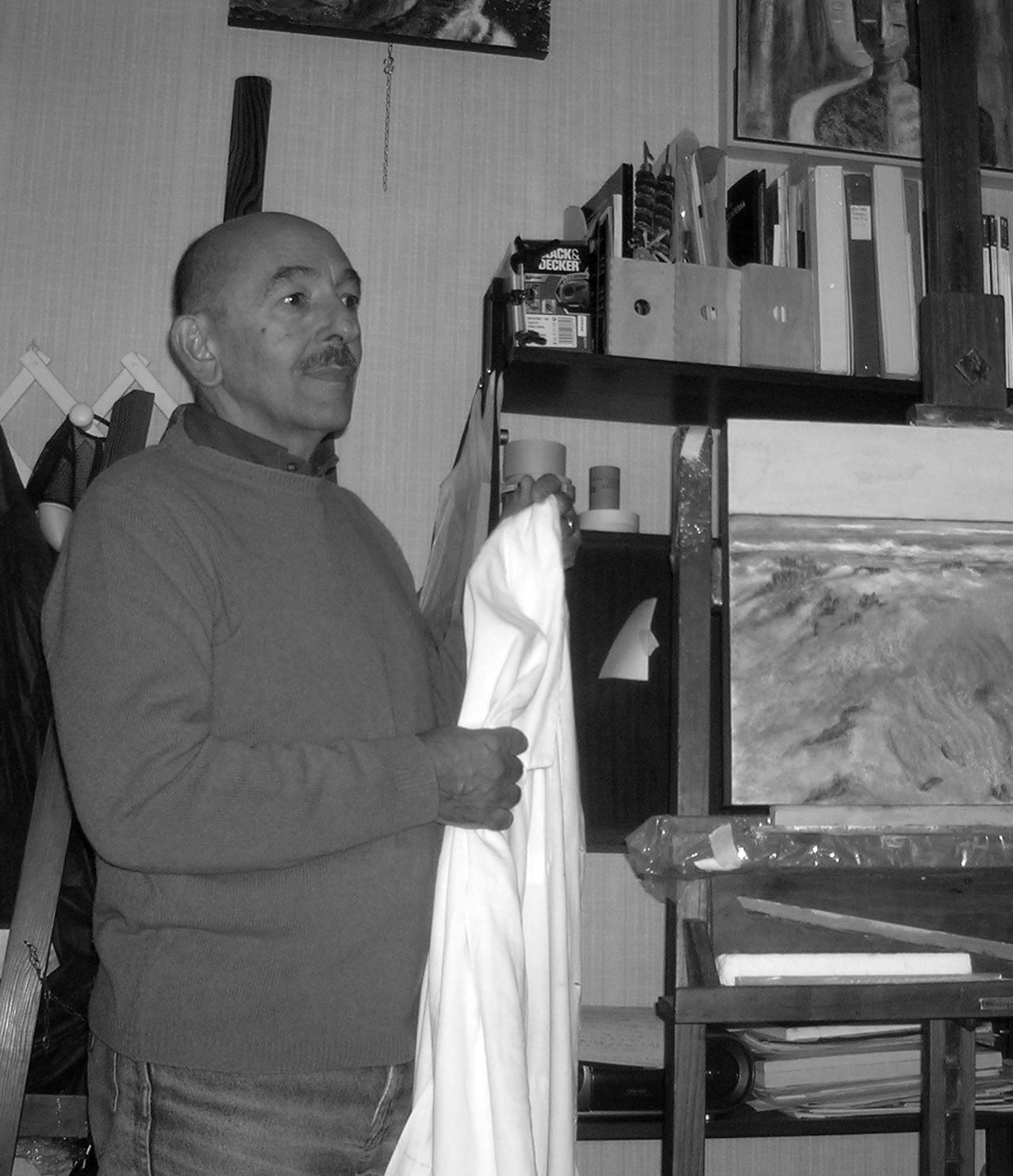
Guido Villa was born in Alfonsine, in the province of Ravenna. He trained first as an industrial chemist and later graduated in Sociology.
From the technical drawing of his secondary school years he turned to painting as a self-taught artist in the early nineteen-seventies. He later attended the “T. Minardi” Municipal School of Drawing, where, in the painting course, he began to express himself in an increasingly experimental manner, using matter itself as colour.
To this day he prefers to paint in oil and mixed media on canvas, or on other supports that he prepares himself, always driven by the desire to experiment with new materials. He lives and works in Faenza.
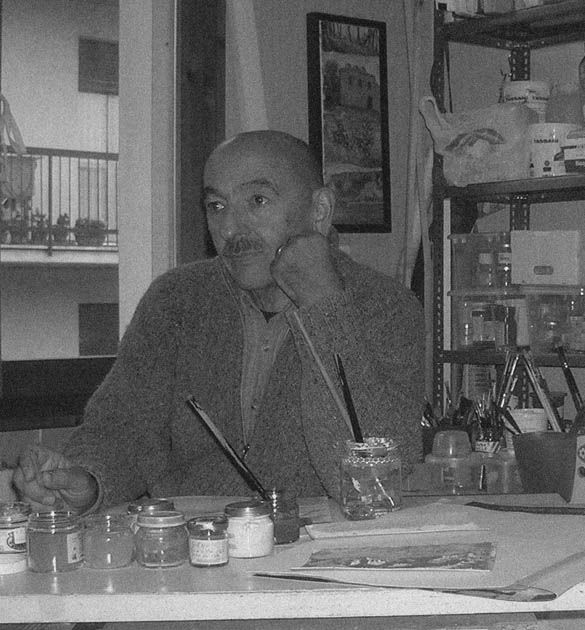
Critical essay
He favours landscape painting with a wholly personal signature, along an experimental path that renews itself over time, using matter itself as colour. He paints in mixed media, oil and acrylic, most often on canvas — old linen-blend bedsheets, jute, printed cloth — and on board or other supports he prepares himself: sand and marble dust, a paste held together with mesh, clay and acrylic. The most recent works in particular are marked by the use of dense material of varying consistency, presenting tactile and visual contrasts.
His love of nature, his predilection for it, finds expression in the most varied landscapes: those of childhood, still vivid in memory — the plains of lower Romagna, the Comacchio valleys in their marshland reality, the valley huts that seem almost to rest upon the water, wrapped in vague, veiled and misty atmospheres. After his move to Faenza came the discovery of the hills in their gentleness or harshness: from the harmonious geometries of cultivated fields played out in yellows and ochres, to the green of narrow Apennine valleys, to the rougher creases of earth that are the clay badlands. Landscapes shifting in bright or muted colour according to the season, always capable of the enchantment of evocative atmospheres.
More recently the landscape motifs have been renewed in the rendering of less familiar places, discovered through travel: the whiteness of Sant’Angelo d’Ischia between the blue of the sea and brown rocks; Morocco, present in several canvases through which runs an almost musical correspondence in the colour blue — the gate of Rabat, a fortified stretch of city wall, an evocative seated figure of a blue Tuareg.
These are works that reveal skill, mastery and command of the craft: sure framing and layout, happily resolved with compositional harmony and balance, in which the control and measure of the composition take nothing away from the emotion felt and conveyed.
Other elements, themes and figures also appear in Villa’s pictorial experimentation: for instance those the painter calls “totems”, in a sense different from the ethnological one — symbolic figures chosen to represent the man of today, with an enigmatic air, motionless, mysterious in their stillness, almost mannequins of metaphysical descent. One of the totems appears with a large hollow in the head, signifying the empty man, the inner void.
Villa also reflects on the course of geological and human history, setting — in his search for remote roots — a great ammonite, a Mesozoic fossil, alongside man. There is also a singular homage to Saint-Exupéry and his Little Prince in the diptych “You will look at the stars, at night”.
Personal interpretative capacity, thoughtful sensibility and a desire for renewal along a path of authentic pictorial experimentation, grounded in well-cultivated natural aptitude: these seem to me the coordinates of Guido Villa’s commendable work, which fully deserves more than superficial attention.
Santa Cortesi, 2009